About two years ago, I started building a writing app.
There wasn’t much of a plan behind it. I had discovered Scrivener, liked the way it approached larger writing projects, and mostly wondered whether I could build something like that for the web.
As it turns out, I could. Sort of.
I rebuilt it several times, changed frameworks, threw away ideas I had spent far too much time on, and slowly stopped trying to build my version of Scrivener. Somewhere along the way, Spleen became its own thing.
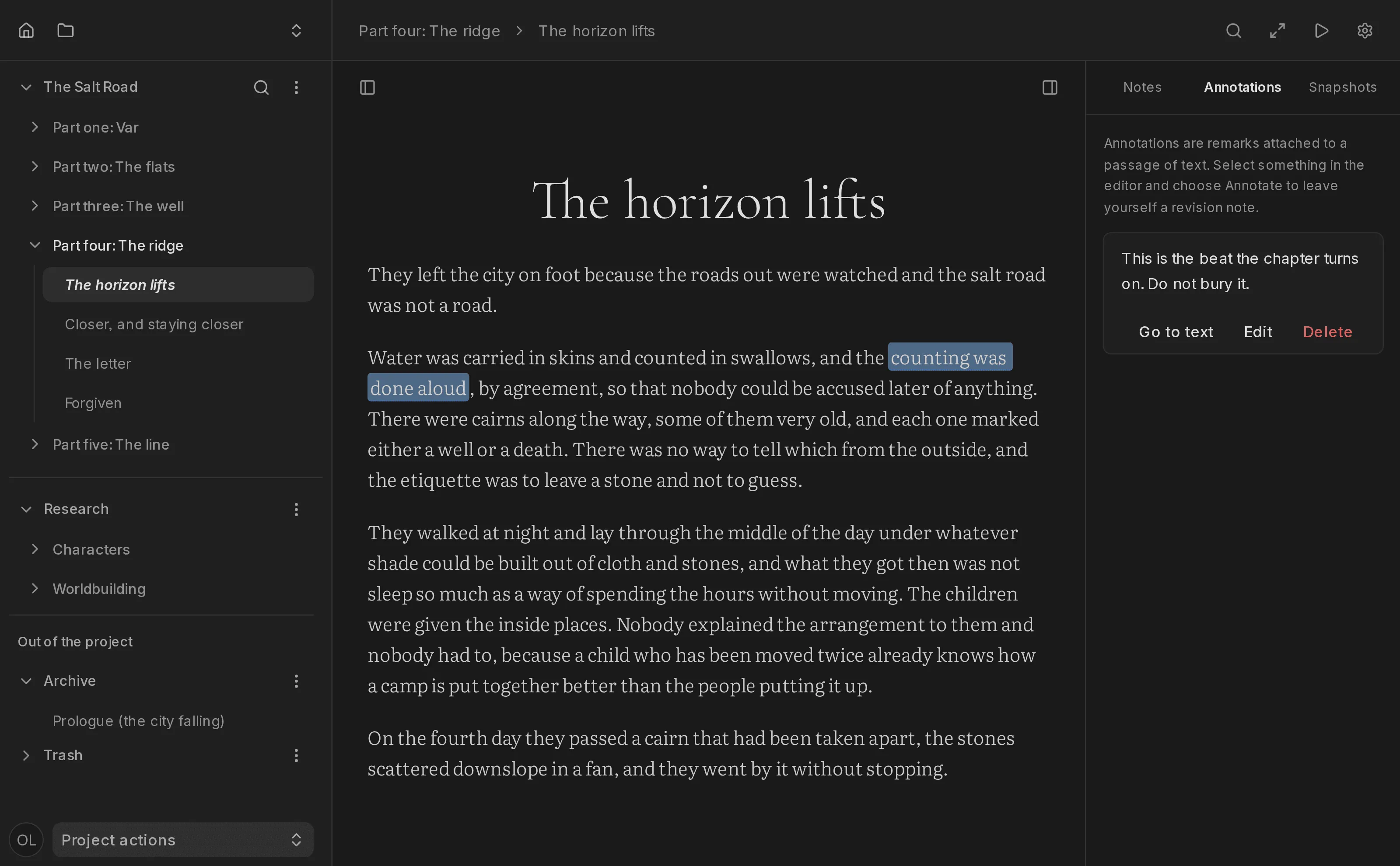
Spleen’s editor, somewhere between “mostly working” and “please don’t click that yet.
The idea today is fairly simple: I want Spleen to be a quiet place to write. Enough structure and tools to work on something substantial, but without turning writing into project management. No streaks, goals, badges or dashboards telling you how productive you have been. Open your project, find your place, and write.
For quite a while Spleen has been one of those projects that technically existed, but only really for me. I’ve been designing it, programming it, breaking it, fixing it and using it myself.
That is about to change.
Spleen has now reached its first public alpha. I’m deliberately not adding another pile of features at this point. I want to find out what happens when people other than me actually sit down and try to write with it.
So I’m looking for a small number of founding testers.
You don’t need to be technical. In fact, I’d particularly like to hear from people who simply write — fiction, essays, poetry, notes, or something else — and are willing to use an unfinished piece of software and tell me when something is confusing, annoying, broken, or surprisingly useful.
This is still an alpha. Things will break. Things will change. There will almost certainly be things I thought were obvious that turn out not to be obvious at all.
That’s rather the point.
After two years of building Spleen mostly by myself, I think it’s time to let a few other people in.
If you’d like to be one of the first people to use Spleen, you can sign up here.
Comments are powered by Giscus, which uses GitHub Discussions. By commenting, your GitHub username and profile picture will be public. See GitHub's Privacy Statement for details.